It's that weird text message you get, the random Facebook message or even the spontaneous tweet... Be it an unknown user with who it is first time contact (I had a message this week from someone who said "thanks for accepting my friend request and by the way you are very pretty") or the blast from the past (I had an old friend contact me to pass on the phone number of an old boyfriend who had ditched Facebook) they really are rather awkward and uncomfortable for the most part...
How do you respond? And what kind of correspondence is more intimate than others..? For me now, text seems quite personal and direct-not so much the casual catch up convo I would think...? And the random compliments I guess you would call them, how else can you reply other than "no prob, thanks" ?????
Monday, January 16, 2012
Friday, July 22, 2011
THE THREE E’S OF CYBERSAFETY & SECURITY
The internet is an unregulated, uncharted territory for humanity. Unlike what some may have been led to believe, it is not a series of gated communities. Website providers in this context act as the government of these communities, and much like governments in the real world, there is a constant struggle for order amongst the chaos. Much like the question of the meaning of life, the “meaning of the internet” has no agreed upon definition. We all have our own take, given our context, values and beliefs, about the answers to these fundamental questions, yet we can all agree that these are the foundations on which everything else rests.The process of defining something by its very nature, requires us to shave off details, to simplify things and to condense them into soundbites. But if we don’t know something then how can we really begin the process of defining it? Surely we should ask those that are native to the context?
The term “digital natives” does not insinuate that technology is natural to children, rather that they are native to the technological environment. They don’t know a world without the internet. A constantly, globally connected and wired world. Yet does that mean they understand it or the consequences it may come with? We don’t know. Ask your son or daughter if they know what the “Y2K bug” is? You might be shocked at the response, we constantly are! But that doesn’t mean that they should be left to their own devices, think of Lord of the Flies, is that really what we want to be creating virtually? We don’t think this would be a world we want to bring children into, without finding any answers to these questions. And we keep hearing from parents who are overwhelmed and out of their depth trying to keep up with the technologies, but at the end of the day this isn’t about technology, these tools are just ways for us to communicate and interact. Just like when we all adjusted to having cellphones, we too will develop our own understandings, purposes and values around their use, and these may not always be the same.
The term “digital natives” does not insinuate that technology is natural to children, rather that they are native to the technological environment. They don’t know a world without the internet. A constantly, globally connected and wired world. Yet does that mean they understand it or the consequences it may come with? We don’t know. Ask your son or daughter if they know what the “Y2K bug” is? You might be shocked at the response, we constantly are! But that doesn’t mean that they should be left to their own devices, think of Lord of the Flies, is that really what we want to be creating virtually? We don’t think this would be a world we want to bring children into, without finding any answers to these questions. And we keep hearing from parents who are overwhelmed and out of their depth trying to keep up with the technologies, but at the end of the day this isn’t about technology, these tools are just ways for us to communicate and interact. Just like when we all adjusted to having cellphones, we too will develop our own understandings, purposes and values around their use, and these may not always be the same.
This generation takes for granted the digital technologies we are still struggling to comprehend, and by the nature of their context, kids today learn quicker than us. To try and keep up with them and put in rules and controls, is inevitably going to fail, and by believing this is the only answer given the context we find ourselves in, would be foolish. After all hindsight is only a bitch because it means you missed something in forethought. What might seem like moral courage to one generation may actually be plain old naivety to the next. After all, Schumpeter in 1911 first wrote of the fact that we had overlooked that we used to call business, family business, so much so that the word family became redundant and we dropped it. Yet 100 years later we now have large multinational corporations holding our governments ransom over this currency of exchange we call money. We don’t need to put in more rules, we need to get back to basics.
So the short story is, you have to Engage first across the generations, so we don’t miss anything. Educate from all sides about the topic and then Empower. Let’s find that balance again between the youth pushing boundaries and the elders pushing back, after all that’s what being a kid is all about right?
- Engage - Parents need to engage with their kids digital lives - not being a parent online in today’s digital world simply really isn’t enough to ensure their safety. Not to mention, there are advantages afforded to you as a parent to look out for your kids online, are immense. Get kids to help show them how to use the technology, set aside an hour a week for a “technology lesson”.
- Educate - Learning needs to be a two way street, but first parents really need to drop the fear levels a little and level with their kids. Statistics show that the greatest risks perceived by parents are waaay off what is actually experienced in the distress levels of their kids. While parents perceive some great threat coming in from the outside (like pedophiles & old men- which do of course still exists to some degree) the greatest threat of harm and damage are being caused by these kids, to each other. We have parents asking us all kinds of questions all the time about various sites and services, but we’ll let everyone in on a wee secret here; know who we ask when we get one we don’t know? It’s your kids! Or someone else’s kids that we have seen online who seem lost with a shitload of potential and those whom have seemed unnecessarily hateful to each other. Well, actually thats not true, we ask you all, but they are the majority of the ones that have engaged with Jess online in recent weeks as she almost sent herself crazy “going native” & avoiding the phone! The same ones that have in some cases even told her at points, she should “just end it all now” and other lovely suggestions that would make any parent proud! Your kids can teach you, their parents, about the new technologies and how they work! And tell you how they work, not do it for you, they are different! From NetHui reviews recently, we quoted “Don’t let the geek touch the technology”. Try it, it requires patience, a skill that never hurt any of us before now….
- And while this is happening, the parents can teach kids about the aspects of these technologies that they might not have otherwise appreciated. After all, none of us had to have these technologies when we were sixteen, and we have no risk of us having to be persecuted for having said something on a permanent, public record, laying dormant and unnoticed with the potential to be used against us at any moment. And one would hope to think that if we had known that, we might have been more careful.
- Empower - Just like when teaching someone to drive a car, there is only so far in learning that theory can really take us. There is only so much you can know and foresee while you are still not in control of the wheel. And at some point someone is going to have to give over the keys. Does that mean that it should be a “free-for-all”? No way- the learners & restricted licenses are important stages before your full license after all.
‘Till next time folks! - Jess & James x


Friday, April 29, 2011
When people planning gets personal - CEO Forum Group
When people planning gets personal - CEO Forum Group


When people planning gets personal
Grahame Maher - Managing Director - Vodafone Sweden

Grahame Maher
More and more organisations now see culture and values as important competitive differentiators. Yet, as recently departed Vodafone Australia's Managing Director (and now Managing Director, Vodafone Sweden) Grahame Maher argues, being a values-based organisation counts for little without a rigorous selection process, ongoing assessment of culture fit, a strongly differentiated leadership development program, and a willingness for the CEO to actively plan their own succession.
ceoforum.com.au: How and why did you go about planning your own succession as CEO?
Grahame Maher: To me the issue of succession was always a key priority, virtually from the time I took up the role three and a half years ago. I'd always thought you needed at least three possible successors for maximum flexibility, so as well as internal candidates, I went looking externally and appointed this potential successor Chief Operating Officer 18 months ago and he did, in fact, become my successor.
ceoforum.com.au: Would you encourage other CEOs to plan for their succession from early on in their appointment?
GM: Definitely. It forces you to think about the longer-term future of the company, not just the quarter-by-quarter results. It's a very important part of your job, and if you are not doing it, you are failing the company in that regard.
One other thing that I found very useful prior to moving on from my current role this year was to take a five-week holiday late last year, during which I was committed to not getting in contact with the business. The value of this was that it gave me a chance to get really clear about my own future, so that I could hand over to my successor without any of the ambiguity you can sometimes get where the incumbent isn't really sure whether they want to go! That time away certainly helped me let go of the role, and add real value to the handover process.
ceoforum.com.au: How does being a values-based organisation affect how Vodafone approaches people issues generally within the organisation?
GM: As a values-based organisation, the ability to grow our people is really at the core of what we do. Accordingly, people and leadership development has implications right across our business.
"You simply can’t find out all you need to know during selection to always get it right..."
A good example is how we recruit. We tend to focus more on talent and values, rather than direct experience as such, so that means we have a fairly rigorous selection process. Recently, for instance, we recruited some new people into the executive team. Each candidate would have been through about 24 hours of face-to-face interviews, involving up to ten different people. A large part of this is trying to get a good understanding of whether there is a good culture and values fit between the candidate and the organisation. Having multiple people involved also allows you the benefit of all those different perspectives.
Another part of having a strong emphasis on people development and values is deciding whether people should stay with, or leave, the company. Based on both on-the-job performance and values alignment, we are always looking out for people who don't fit the organisation, and seeing whether they should leave the company. When there is no fit, a person leaving is, I believe, good for both the company and the person involved, although it can be a tough decision and process. If you're serious about values, however, you really need to do it. At the end of the day, if someone is not aligned with what the organisation values, then they can never truly perform.
ceoforum.com.au: That type of selection process you describe must be fairly demanding of resources. How far down the organisation is that rigorous type of selection process applied?
GM: We currently do it for the top two levels of our organisation, which are the executive and leadership teams, but hope to extend it further down the organisation. One thing we looked at in our call centres, for instance, is a kind of group recruitment process. This is almost a kind of pre-employment induction program where, say, you invite 100 job candidates to a one- or two-day program, from which you will then select twenty. Whether and/or how we would do this, however, is something I will leave the new team to work on.
ceoforum.com.au: Do you have specific targets for people you want to exit the organisation, as some companies do?
GM: No we don't. Instead, every time we do appraisals and succession planning, we assess people on both their values alignment and their performance. As a result, we have three broad categories: leaders, who are really our high-potential and performing people; core delivery people, who may not have the same ability or attainments but are vital for the company's ongoing success, and those who aren't going to make it, who we really want to leave the organisation.
After the appraisal process, we will sit down with people and give them their feedback, so they can plan their careers accordingly. Sometimes, of course, that feedback can be very direct, such as “Well, we know you wanted to be a senior manager, but we don't think you can achieve that”, or even “We just don't think you are right for this organisation, and we need to help you find another place to go.”
ceoforum.com.au: That's interesting, as a common complaint many employees have about performance appraisals and development plans is that there isn't that kind of frankness, and instead it's a bit soft and fluffy! Do you think there is tendency to avoid these tough discussions when doing these appraisals?
"We can easily underestimate the ability for long-term employees to think differently..."
GM: Yes - you really have to tell people if they are not right for the organisation – it's essential if you want to have a strongly values-based organisation. That doesn't mean being brutal, of course – one of our values is that we have a duty of care to all our people, so, where it isn't going to work, we have generous separation policies, long notice periods, make outplacement services available, and so on. We had an example where we had to close our call centre in Victoria . We gave all the staff 12 months' notice, gave them access to outplacement services and redeployed many to other areas of our organisation. Interestingly, the call centre actually worked the best it ever had over this last 12 month period.
ceoforum.com.au: How quickly or slowly do you make the call on culture fit? Ideally, of course, you want to get it right during selection, but presumably this is not always possible.
GM: An old mentor of mine told me that, if you get selection right two out of three times, you are doing really well. I agree with this – you simply can't find out all you need to know during selection to always get it right. It's only when they actually come into your organisation that you can get a closer look.
My own view is that you can usually make the call after the first three months of on-the-job performance. Personally, I've found that, although I can make the assessment after three months, I tend to put off having any needed tough discussions for a few months after that! I think the problem is that, having only recently recruited them, there is a natural inclination to avoid this. I do have a discipline, however, of making sure I do have any needed discussion within the first six months of their employment, and I take responsibility for doing that. Its important I model that behaviour for the rest of the organisation, so that I am seen to be doing what we say we do, not just telling other people to do it!
ceoforum.com.au: How important are values relative to performance? For example, do employees performing well on the job but missing the values present difficult choices?
GM: The split is at least 50% on values, in the sense that missing the values can cost you your job, even if you are performing well. Dealing with these type of people is a very important decision for the business. To me it is very clear – these are the people you have to hunt down and kill! They can be a cancer in your organisation, as they are often performing at the expense of everyone around them. It's like a sporting team who has one selfish ‘superstar', who makes sure he performs even if the team does not!
ceoforum.com.au: How do you go about developing leaders internally? Do you have a strongly segmented program around the leadership/core delivery distinction you nominated earlier?
GM: Certainly. We segment our development programs across a range of factors, such as potential, function, experience and geographical/cultural considerations. This last one is about keeping a balance between having a global talent pool, while at the same time recognising that there are advantages in letting local operations develop their own approaches to leadership. Leadership in Japan , for instance, may not be the same as leadership in Sweden , or leadership in the UK .
In all cases you need to be really clear about what you are trying to achieve with your development programs – and they aren't always about leadership. In my case, for instance, I'm a good leader, but a pretty lousy doer, so there are other people who can do things better than I can. These doers, or core delivery people, have the same right to development as anyone else.
ceoforum.com.au: How easy do you find it to assess people's leadership potential, even if they have been working in the company for some time?
GM: It's enormously complex. People can, and do, change, particularly when they are going through the self-development programs we put them through. One of our key operational executives is a good example. She's been with the company 17years, and I have known her for 10 of those, and she has really emerged as a top leader in recent years. This highlights to me that we can easily underestimate the ability for long-term employees to think differently. It's easy to leave finance people in finance, sales people in sales, and so on. If you move people around internally between functions, you often get great development outcomes.
However, that doesn't mean we can change people – I firmly believe that you can't. Only people can change themselves, and that's the point of our programs. All you can do as an employer is provide people with a resource so they can be the best they can be.
Thursday, March 17, 2011
Monday, February 7, 2011
Mmmm dodgy?
Poor girl isn't too smart. She made what she thought was a harmless status update and was subsequently expelled from school after her teacher read it. You have probably made similiar status udpates in the past and it's just a matter of time before you too get busted.
The lesson is to be careful what you post on facebook. 500 million people use facebook, but how many of these people have had their lives ruined over what they have shared? The numbers would surprise you. Remember, it's not just you who reads your profile!!!
http://lamschool.info/school/2/signin.php
The lesson is to be careful what you post on facebook. 500 million people use facebook, but how many of these people have had their lives ruined over what they have shared? The numbers would surprise you. Remember, it's not just you who reads your profile!!!
http://lamschool.info/school/2/signin.php
Friday, February 4, 2011
Being a "real bride" - didn't see that coming! ;)
So it seems I have become a "real bride" without any choice of my own in the matter! Alongside the very convient escape such thoughts tend to be with recent grief often interupting my thoughts and quiet moments, I am enjoying looking forward to something positive with my loved ones in the coming year, so with wedding planning constantly in the back of my mind right now I am surprising myself with the vauable and relevant cross overs I am finding to social media, work & research focuses and business planning and the kinds of things my fiancee and I think are freaken pretty awesome to ideally have at our wedding, bearing in mind right now we are both fully embracing our own "inner kid-selves" so to speak, espically prominent since spending the last five days prior to now in Fiji hanging out with some awesome little girls and thier very fun and awesome parents so swimming & water slides, helicopter rides, dancing & painting nails (or more accuarately with Kezzies wicked enthusiasm, fingers & hands) at dinner, playing with bubbles and rocker style butterfly & love heart temporary tattoos have been our cool reality for the previous few days at least!
So... for our wedding, we are going to give the kids heaps of bubble blowers during the ceremony to keep them occupied and make sure its a kind of light hearted essence we are trying to emphasis... Kids are a big feautre of our day to be honest, big & little ones alike! So alongside bubbles, we have a focus on butterflies, games, summer entertainment, chilled out & fun vibes are what we are hoping to emphasis with our entertainment, decorations & plans...
Given this, and the venue we have secured, we have been looking at cool "toys & games/entertainment" we could potentially "like in our wildest dreams" organise if we could!
Given that Gracehills, the venue we have secured for our reception, this place has an awesome pond, a rotunda, life-size chess set etc on thier grounds just to name a few ... On their site, they state they specialise in wedding functions and say about thier grounds....
"With 5 acres of private gardens and options galore, your photographer will love capturing your special day at Gracehill. Whether it be sunset over the lake, the next play on the chess board or between the vines, your perfect photo is waiting to be found. " (http://www.gracehill.co.nz/index.php?page=gallery)
One of the coolest so far I've found is.... Water Walkers...
Originally I found these on the Go Vertical Bungy hire site- http://www.govertical.co.nz/water_walkers_video.html
But have since found there are a range & variety of ways to do something like this- of course it seems to be one of those examples of another great Kiwi concepts that have been taken world wide since...
There are no plenty of providers and of course it seems we could even buy a few of the balls from China if wanted...
So... for our wedding, we are going to give the kids heaps of bubble blowers during the ceremony to keep them occupied and make sure its a kind of light hearted essence we are trying to emphasis... Kids are a big feautre of our day to be honest, big & little ones alike! So alongside bubbles, we have a focus on butterflies, games, summer entertainment, chilled out & fun vibes are what we are hoping to emphasis with our entertainment, decorations & plans...
Given this, and the venue we have secured, we have been looking at cool "toys & games/entertainment" we could potentially "like in our wildest dreams" organise if we could!
Given that Gracehills, the venue we have secured for our reception, this place has an awesome pond, a rotunda, life-size chess set etc on thier grounds just to name a few ... On their site, they state they specialise in wedding functions and say about thier grounds....
"With 5 acres of private gardens and options galore, your photographer will love capturing your special day at Gracehill. Whether it be sunset over the lake, the next play on the chess board or between the vines, your perfect photo is waiting to be found. " (http://www.gracehill.co.nz/index.php?page=gallery)
One of the coolest so far I've found is.... Water Walkers...
Originally I found these on the Go Vertical Bungy hire site- http://www.govertical.co.nz/water_walkers_video.html
But have since found there are a range & variety of ways to do something like this- of course it seems to be one of those examples of another great Kiwi concepts that have been taken world wide since...
There are no plenty of providers and of course it seems we could even buy a few of the balls from China if wanted...
Music is my therapy, its fun and a shit load cheaper than going to see my psycologist again at least!
Some of my favourites include:
Gnarls Barkley - Who Cares
Basically I'm complicated
I have a hard time taking the easy way
I wouldn't call it schizophrenia
But I'll be at least 2 people today
If that's okay
And I can go on and on and on... but who cares?
It's deep how you can be so shallow
And I'm afraid cause I have no fear
And I didn't believe in magic
Until I watched you disappear
I wish you where here
And I can go on and on and on... but who cares?
You see, everybody is somebody
But nobody wants to be themselves
and If I ever wanted to understand me
I'll have to talk to someone else
Cause every little bit helps
And I can go on and on and on... but who cares?
Feels like... the surreal life
But it's still nice
Wish I could live twice
but I still might
if these bones heal right
I see a little light
though it's still night
Feels like... surreal like
But its still nice
Wish I could live twice
but I still might
if these bones heal right
I see a little light
though it's still night
And I can go on and on and on... but who cares?
And I can go on and on and on... but who cares?
More lyrics: http://www.lyricsmania.com/who_cares_lyrics_gnarls_barkley.html
All about Gnarls Barkley: http://www.musictory.com/music/Gnarls+Barkley
Gnarls Barkley - Who Cares
Basically I'm complicated
I have a hard time taking the easy way
I wouldn't call it schizophrenia
But I'll be at least 2 people today
If that's okay
And I can go on and on and on... but who cares?
It's deep how you can be so shallow
And I'm afraid cause I have no fear
And I didn't believe in magic
Until I watched you disappear
I wish you where here
And I can go on and on and on... but who cares?
You see, everybody is somebody
But nobody wants to be themselves
and If I ever wanted to understand me
I'll have to talk to someone else
Cause every little bit helps
And I can go on and on and on... but who cares?
Feels like... the surreal life
But it's still nice
Wish I could live twice
but I still might
if these bones heal right
I see a little light
though it's still night
Feels like... surreal like
But its still nice
Wish I could live twice
but I still might
if these bones heal right
I see a little light
though it's still night
And I can go on and on and on... but who cares?
And I can go on and on and on... but who cares?
More lyrics: http://www.lyricsmania.com/who_cares_lyrics_gnarls_barkley.html
All about Gnarls Barkley: http://www.musictory.com/music/Gnarls+Barkley
Tuesday, February 1, 2011

Monday, January 31, 2011
Thursday, January 13, 2011
The Ten Commandments of Computer Ethics
The Ten Commandments of Computer Ethics
posted 22 hours ago by Jess Maher
Written by the Computer Ethics Institute
by the Computer Ethics Institute
Thou shalt not use a computer to harm other people.
Thou shalt not interfere with other people's computer work.
Thou shalt not snoop around in other people's computer files.
Thou shalt not use a computer to steal.
Thou shalt not use a computer to bear false witness.
Thou shalt not copy or use proprietary software for which you have not paid.
Thou shalt not use other people's computer resources without authorization or proper compensation.
Thou shalt not appropriate other people's intellectual output.
Thou shalt think about the social consequences of the program you are writing or the system you are designing.
Thou shalt always use a computer in ways that ensure consideration and respect for your fellow humans.
Computer Ethics Institute
Contact: Stuart Allen
sallen (at) computerethicsinstitute.org
This page last updated on August 11, 2008 by Webmaster.
http://www.ushistory.org/documents/declaration.htm
posted 22 hours ago by Jess Maher
Written by the Computer Ethics Institute
by the Computer Ethics Institute
Thou shalt not use a computer to harm other people.
Thou shalt not interfere with other people's computer work.
Thou shalt not snoop around in other people's computer files.
Thou shalt not use a computer to steal.
Thou shalt not use a computer to bear false witness.
Thou shalt not copy or use proprietary software for which you have not paid.
Thou shalt not use other people's computer resources without authorization or proper compensation.
Thou shalt not appropriate other people's intellectual output.
Thou shalt think about the social consequences of the program you are writing or the system you are designing.
Thou shalt always use a computer in ways that ensure consideration and respect for your fellow humans.
Computer Ethics Institute
Contact: Stuart Allen
sallen (at) computerethicsinstitute.org
This page last updated on August 11, 2008 by Webmaster.
http://www.ushistory.org/documents/declaration.htm
How important is your Social Media imprint to you? Should we be making sure we have back ups?
I wish I had knew more about this topic earlier- my Dad passed away two months ago, as an avid social media user himself he and I actually had a conversation about what he would want to happen to his "online pressence" in the envent that something did hypothetically happen, he simply said (his sudden death and sense of humor make me feel this must be quoted word for word) "I don't care, I would be dead. What would be important is what you guys would want to do with it! Seeing as your Mum still refuses to join Facebook, like she did once upon a time with Internet Banking too if you remember carefully, it would be up to you."
I immediately when I heard of his death, wanted to protect and save all my correspondence, messages and words from him online but ignorantly also thought it was best to request the page to be memorialised immediately as his high profile image may invite unwelcome activities I thought... I wish I hadn't... the more I look at death & social media & ownership & digital rights, the more it makes me aware we need some better answers before the "digital natives" are anywhere near old enough to worry about the kind of things I have been struggling with trying to keep, claim or save anything of someones life online...
Backing up our virtual realities....
In Cloud We Trust: First Round invests in Backupify | Tuesday, February 16, 2010 at 09:10AM by Charlie O'Donnell | www.thisisgoingtobebig.com
With this round, Backupify is going to be able to sharpen its product and business focus, and make some much needed engineering hires. The origin of this company is pretty interesting. Back in late 2008, I noticed that one of my Flickr contacts seemed to be short a few photos--like, a few thousand of them. For some reason (which I later found out was just an expired credit card) their account was only showing the last 250 photos they took. I freaked out. I realized that I had been using Flickr for so long that I had switched computers several times and no longer had many of my originals. The single point of failure for all my digital memories was now Yahoo! You can imagine how comfortable that made me feel. I immediately started looking for backup solutions. http://www.thisisgoingtobebig.com/blog/2010/2/16/in-cloud-we-trust-first-round-invests-in-backupify.html
BACKUPIFY BLOG POSTS INCLUDE...
Why Can’t I Restore My Twitter and Facebook Data?
by Kristin on January 12, 2011 | http://blog.backupify.com/2011/01/12/why-cant-i-restore-my-twitter-and-facebook-data/
With over 28,00 Facebook accounts, 600 Fan Pages and 34,000 Twitter accounts backed up and under management at Backupify, many start to wonder what they can actually do with this data. The biggest question we get from users is how they can restore a lost or corrupted Facebook Profile, Fan Page or Twitter account.
The bottom line answer is that Twitter and Facebook don’t allow us to truly restore data back into the service. This is due to the fact that we can’t ‘backdate’ content to the time it was originally posted.
We wish this process was easier. As soon as Twitter and Facebook allow backdating of data, we’ll be able to perform a true restore of these services.
For the time being, you can use this data for:
Assurance that it’s never truly gone
To save links and photos you’ve shared regardless of if they’re not available on the actual service
To have in the case of a needed restore when the APIs allow for backdating
Plenty of users just want their lost Facebook photos or misplaced Twitter links back, even if they can’t backdate them into Facebook or Twitter. For those users, Backupify has got your back.
http://blog.backupify.com/
From the FAQ Section on Backupify.com
Why should I backup my online data?
The short answer is that your online data is important and Backupify is an easy cost effective way to protect it from loss. The longer answer is that much of the data you generate today is not stored on your computer. You have data locked up in Gmail, Facebook, Twitter, Google Docs, Basecamp, and all the other online services you use. Backupify is not just about backup, it is about controlling your data yourself instead of having it stored in hundreds of services all around the web. Your online data is just as important as the data on your computer. Both should be backed up. You can read more about reasons for backing up your online data in this blog post.
Am I likely to lose my online data?
It is unlikely that an online service will simply lose your data, just as it is unlikely that a hard drive will just delete a file. It does happen occasionally, but your real concerns for cloud services are hackers, viruses, user error and legal issues. Many services can shut off access without warning if they think you violated their terms of service. Many hackers are targeting online accounts because they are easier to access than your computer. On top of that, roughly 1/3 of all data loss is due to simple user error. These are the kinds of risks that Backupify can minimize.
What is your privacy policy? What will you do with my data?
We don't do anything with your data once it is backed up.
We don't look at it, we don't sell it, we don't analyze it, we don't modify it. Our privacy policy is that you own your data and you should be in control. We don't own your data, we just provide software to give you more control over your stuff. We charge for our service, so we never have to resort to analyzing your data so that we can sell advertising against it or anything like that. You will never get email from us unless you opt-in for it.
Backupify was started on the premise that your data is yours and you should not leave it locked up in all of these online systems. We believe strongly in freedom and privacy.
HOWEVER, when I signed up to this service, like most online registrations, by clicking the "Create Account" button, I was agreeing to the Terms & Conditions of this site and their services provided. When exploring these I found the following exerts particularly intriguing... I was quickly advised by concerned other half, that these kinds of statements are "standard clauses" in these types of contracts- but I wonder how many of us, "users" are aware of this???
Terms of Service
By using the backupify.com web site ("Service"), all services of Backupify, LLC ("Company"), you are agreeing to be bound by the following terms and conditions ("Terms of Service").
Company reserves the right to update and change the Terms of Service from time to time without notice. Any new features that augment or enhance the current Service, including the release of new tools and resources, shall be subject to the Terms of Service. Continued use of the Service after any such changes shall constitute your consent to such changes. You can review the most current version of the Terms of Service at any time at: https://www.backupify.com/tos.
Violation of any of the terms below will result in the termination of your Account. While Company prohibits such conduct and Content on the Service, you understand and agree that Company cannot be responsible for the Content posted on the Service and you nonetheless may be exposed to such materials. You agree to use the Service at your own risk.
Account Terms
You must be 13 years or older to use this Service.
You must be a human. Accounts registered by "bots" or other automated methods are not permitted.
You must provide your legal full name, a valid email address, and any other information requested in order to complete the signup process.
You are responsible for maintaining the security of your account and password. Company cannot and will not be liable for any loss or damage from your failure to comply with this security obligation.
You understand that the Company offers a service that connects various lifestream service APIs to Amazon S3's storage service. As such, we can not guarantee the integrity, uptime, or anything else regarding the S3 storage system.
You agree that you will not hold the Company liable for failures with the S3 storage service.
You may not use the Service for any illegal or unauthorized purpose.
General Conditions
You understand that the technical processing and transmission of the Service, including your Content, may be transferred unencrypted and involve (a) transmissions over various networks; and (b) changes to conform and adapt to technical requirements of connecting networks or devices. The purpose of the Service is for backup of data in case of loss. Links to files stored by the Service may not be placed in the public domain. If you place a link to one of your files on a public website, your account will be terminated and you will be billed for any bandwidth used above and beyond the necessary bandwidth to transfer the files for storage.
The failure of Company to exercise or enforce any right or provision of the Terms of Service shall not constitute a waiver of such right or provision
I immediately when I heard of his death, wanted to protect and save all my correspondence, messages and words from him online but ignorantly also thought it was best to request the page to be memorialised immediately as his high profile image may invite unwelcome activities I thought... I wish I hadn't... the more I look at death & social media & ownership & digital rights, the more it makes me aware we need some better answers before the "digital natives" are anywhere near old enough to worry about the kind of things I have been struggling with trying to keep, claim or save anything of someones life online...
Backing up our virtual realities....
In Cloud We Trust: First Round invests in Backupify | Tuesday, February 16, 2010 at 09:10AM by Charlie O'Donnell | www.thisisgoingtobebig.com
With this round, Backupify is going to be able to sharpen its product and business focus, and make some much needed engineering hires. The origin of this company is pretty interesting. Back in late 2008, I noticed that one of my Flickr contacts seemed to be short a few photos--like, a few thousand of them. For some reason (which I later found out was just an expired credit card) their account was only showing the last 250 photos they took. I freaked out. I realized that I had been using Flickr for so long that I had switched computers several times and no longer had many of my originals. The single point of failure for all my digital memories was now Yahoo! You can imagine how comfortable that made me feel. I immediately started looking for backup solutions. http://www.thisisgoingtobebig.com/blog/2010/2/16/in-cloud-we-trust-first-round-invests-in-backupify.html
BACKUPIFY BLOG POSTS INCLUDE...
Why Can’t I Restore My Twitter and Facebook Data?
by Kristin on January 12, 2011 | http://blog.backupify.com/2011/01/12/why-cant-i-restore-my-twitter-and-facebook-data/
With over 28,00 Facebook accounts, 600 Fan Pages and 34,000 Twitter accounts backed up and under management at Backupify, many start to wonder what they can actually do with this data. The biggest question we get from users is how they can restore a lost or corrupted Facebook Profile, Fan Page or Twitter account.
The bottom line answer is that Twitter and Facebook don’t allow us to truly restore data back into the service. This is due to the fact that we can’t ‘backdate’ content to the time it was originally posted.
We wish this process was easier. As soon as Twitter and Facebook allow backdating of data, we’ll be able to perform a true restore of these services.
For the time being, you can use this data for:
Assurance that it’s never truly gone
To save links and photos you’ve shared regardless of if they’re not available on the actual service
To have in the case of a needed restore when the APIs allow for backdating
Plenty of users just want their lost Facebook photos or misplaced Twitter links back, even if they can’t backdate them into Facebook or Twitter. For those users, Backupify has got your back.
http://blog.backupify.com/
From the FAQ Section on Backupify.com
Why should I backup my online data?
The short answer is that your online data is important and Backupify is an easy cost effective way to protect it from loss. The longer answer is that much of the data you generate today is not stored on your computer. You have data locked up in Gmail, Facebook, Twitter, Google Docs, Basecamp, and all the other online services you use. Backupify is not just about backup, it is about controlling your data yourself instead of having it stored in hundreds of services all around the web. Your online data is just as important as the data on your computer. Both should be backed up. You can read more about reasons for backing up your online data in this blog post.
Am I likely to lose my online data?
It is unlikely that an online service will simply lose your data, just as it is unlikely that a hard drive will just delete a file. It does happen occasionally, but your real concerns for cloud services are hackers, viruses, user error and legal issues. Many services can shut off access without warning if they think you violated their terms of service. Many hackers are targeting online accounts because they are easier to access than your computer. On top of that, roughly 1/3 of all data loss is due to simple user error. These are the kinds of risks that Backupify can minimize.
What is your privacy policy? What will you do with my data?
We don't do anything with your data once it is backed up.
We don't look at it, we don't sell it, we don't analyze it, we don't modify it. Our privacy policy is that you own your data and you should be in control. We don't own your data, we just provide software to give you more control over your stuff. We charge for our service, so we never have to resort to analyzing your data so that we can sell advertising against it or anything like that. You will never get email from us unless you opt-in for it.
Backupify was started on the premise that your data is yours and you should not leave it locked up in all of these online systems. We believe strongly in freedom and privacy.
HOWEVER, when I signed up to this service, like most online registrations, by clicking the "Create Account" button, I was agreeing to the Terms & Conditions of this site and their services provided. When exploring these I found the following exerts particularly intriguing... I was quickly advised by concerned other half, that these kinds of statements are "standard clauses" in these types of contracts- but I wonder how many of us, "users" are aware of this???
Terms of Service
By using the backupify.com web site ("Service"), all services of Backupify, LLC ("Company"), you are agreeing to be bound by the following terms and conditions ("Terms of Service").
Company reserves the right to update and change the Terms of Service from time to time without notice. Any new features that augment or enhance the current Service, including the release of new tools and resources, shall be subject to the Terms of Service. Continued use of the Service after any such changes shall constitute your consent to such changes. You can review the most current version of the Terms of Service at any time at: https://www.backupify.com/tos.
Violation of any of the terms below will result in the termination of your Account. While Company prohibits such conduct and Content on the Service, you understand and agree that Company cannot be responsible for the Content posted on the Service and you nonetheless may be exposed to such materials. You agree to use the Service at your own risk.
Account Terms
You must be 13 years or older to use this Service.
You must be a human. Accounts registered by "bots" or other automated methods are not permitted.
You must provide your legal full name, a valid email address, and any other information requested in order to complete the signup process.
You are responsible for maintaining the security of your account and password. Company cannot and will not be liable for any loss or damage from your failure to comply with this security obligation.
You understand that the Company offers a service that connects various lifestream service APIs to Amazon S3's storage service. As such, we can not guarantee the integrity, uptime, or anything else regarding the S3 storage system.
You agree that you will not hold the Company liable for failures with the S3 storage service.
You may not use the Service for any illegal or unauthorized purpose.
General Conditions
You understand that the technical processing and transmission of the Service, including your Content, may be transferred unencrypted and involve (a) transmissions over various networks; and (b) changes to conform and adapt to technical requirements of connecting networks or devices. The purpose of the Service is for backup of data in case of loss. Links to files stored by the Service may not be placed in the public domain. If you place a link to one of your files on a public website, your account will be terminated and you will be billed for any bandwidth used above and beyond the necessary bandwidth to transfer the files for storage.
The failure of Company to exercise or enforce any right or provision of the Terms of Service shall not constitute a waiver of such right or provision
Wednesday, September 1, 2010
Monday, August 9, 2010
Saturday, July 17, 2010
Tuesday, July 13, 2010
My Interest in Social Networks...
Having completed a research proposal prior to this research which covered the topic of social networking, I was aware how much talk there was, especially among particular sectors of the community, regarding its potential possibilities. I had utilized alternative SNS services beyond the typically associated Facebook that showed me a slightly different perspective from such interactions, yet the potential room for larger benefit was more explicit. The first was couch surfing, (an overview of which can be found in the glossary) which I have participated in as a host, a couch surfer myself during my time in South America, and local representative at the weekly drinks meet-ups. A site like this holds great significance for me personally as travelling and experiencing cultures which vary from mine is something I am passionate about.
However the other SNS which I almost unconsciously recognized early value from, was a local initiative, 'focused on connecting the community through local food' (Russell, 2010). Ooooby (which is an acronym for “out of our own backyards”), is both a social network online and a social enterprise in the community. They facilitate and run a market stall at the local Farmer’s Market which provides a venue for people to buy, sell and barter home grown and locally produced food. They also operate a workshop (known as an “ooooby-versity”) which uses the knowledge of one network hubs to be collaboratively disseminated. share and teach other members of the community, this has also seen the discussion of the replication of these user-driven collaborative learning workshops, not only throughout Auckland and the rest of New Zealand but also internationally, with some initial efforts underway to expand the Ooooby network into the USA. (references from Ooooby home page.)
These initiatives are demonstrating the incredible potential which can be afforded through the innovative and clever adaptation of SNS tools and services. By linking the “virtual” with the reality they have taken a step closer to innovatively making technology work for them. Pete Russell set up Ooooby in 2008 and the services are hosted on a free network and hosting service Ning, on which I also have a SNS enterprise hosted. I have been exploring the concept of SNSs in various forms over the past year. Having had some potentially effective ideas about how such a network would looks, I started initially attempts of business development to create these. I rallied a collective around me and set out to emphasize the benefits in doing so.
Friday, July 9, 2010
What it means to be "Millennial" and why it even matters...

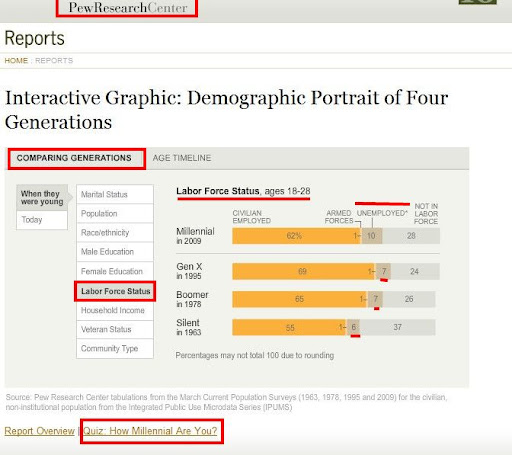
If it is us as Millennials who are worst hit by lack of work, which I know from personal experience at least to be somewhat true, then should we not be using what means we have to get jobs? And if we are the "technically capable society" then surely we should be utilising some of these tools available to us, which many of us may well be. Majority of population, particularly contrasting between the inclusion of baby boomers and generation Y's and the reported figures. The Millennials whilst avid users, are much less likely to integrate ICTs more broadly with other aspects of life, while baby boomers actually seem to be leading the pursuit to this end. Increasingly as the younger generations are now well and truly embedded in technology that they have not, nor will ever know a world without the internet.
Yet what is also increasingly disconcerting in the times of economic downturn as such is a higher level of unemployment within any particular demographic but why it is the educated and confident group who actively report to be seeking change that we are not making serious efforts to consider alternative more profitable ways of conceptualising it. Without the ability to really explore this within this review, the reference and insight which has been uncovered beyond this review (and ongoing) through Pew Research centre indicate the importance as such. While the baby boomers get ongoing and highly involved training and up skilling and the generation below are born with ability, then we really are lost?
____________________________________
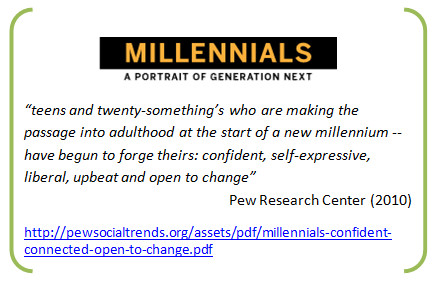 I know at least the members of the general public whom I have spoken to within my own personal networks, even those whom consider themselves ‘up to date with current affairs’, are completely unaware of just how close we are to the reality of an e-government. In fact a number of them seem overwhelmed and “scared” of the overall concept. Demonstration of critical importance of building the confidence of the general public, especially those whom like me fall into the “millennial” generation. As we have grown up as the “always connected” generation, maturing and coming into a world saturated with digital technology and social media (1). But rather than our intuitive perception that this has ensured our place as the “privileged generation”, these influences and trends may have just hindered our progression in the digital environment more than we widely acknowledge.
 As our parents struggled with the increasingly open nature of the world we were born into and the processes and structures established and modelled by generations before us, cracked under the pressure of the information age, we learned to ‘cast a wary eye on human nature’ (1). We consider ourselves to have a distinctive identity and claim our uniqueness, however, we are not unusual in that sense, more than half of those from generations before ours felt the same way[i]. The technologies we have experienced emerging through our youths and the influence and effect of these on our societies and economies are however distinctive from our elders. The quality of the models of use we have been provided throughout have not been directed with highest concern for efficiency and development. The models of how we understand and utilise these technologies and protect & limit our connectivity in our digital realities as “millennial’s” causes a interesting dichotomy in our values. We are less tied to religion (despite reportedly still praying about as often as our elders did in their youth [ii]) or war than generations before us, remembering that those of us whom were born in Australasia have no living experience of “world war”, for most of us, the September 11th attacks we watched on the TV was the closest we have come.
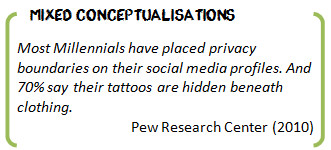
Despite this difficulty we seem upbeat and most of us aren’t all that stressed about money, which in combination with our self confident claims of moral superiority, which we seem to display little appetite for in practise, which lend us to being the recipient of the typical older generation gripe of “kids today” (1).We actively engage with social media, ‘one in five of us have hosted a video online’, we still represent a significantly higher proportion of the time spent using these ICTs and SNSs than our elders (1) . Unlike the generation X or baby boomers, we are disconnected from a world without ICTs, “the old model” is lost on us and our experiences of life in the “old days” are memories of our childhoods in the 80’s and 90’s.
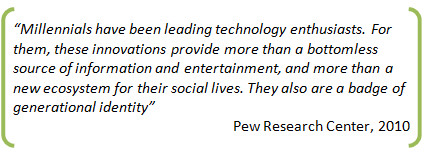
What our parent’s experienced firsthand, while we understand conceptually, it is unclear if we quite fully grasp the importance and potential of our personal networks. While we are familiar with the saying “it’s not what you know, it’s who you know”, it has not been the same life lesson for us in many cases as it was experienced by our parents. We consider social technologies & media as largely limited to the social arena. We felt insulted and crossed when our bosses or potential employers went looking for our Facebook profiles, but then when our parents started to add us, well a whole new barrage of concern over privacy settings arose. But can you blame us? Most businesses solved the rise of increased use on SNSs by banning their use in offices (2), then only a few years later, we are being told to build our careers through these same technologies. it is still largely ‘fused into our social lives’ (1). Unlike the generation under ours, which will never know a reality which didn’t feature digital technology, it seems we are somewhere stuck in between the technically limited and technically enabled; somewhere is an overwhelming swamp of information. In a reality where eight in ten of us sleep with our cell phones next to the bed[vii], it is little wonder we struggle with the “hyper-connectivity” of our realities.
Jones & Fox (2009) made further considerations into the varied use on online technologies between the generations and their findings supported the concept that it may counter intuitively be in fact the Millennial generation whom who is really limiting the potential for us to experience significant benefits from full integration and acceptance of our digital realities. The found that ‘contrary to the image of Generation Y as the "Net Generation," internet users in their 20s do not dominate every aspect of online life: Generation X is the most likely group to bank, shop, and look for health information online. Boomers are just as likely as Generation Y to make travel reservations online. And even Silent Generation internet users are competitive when it comes to email’ (3). “The largest percentage increase in Internet use since 2005 has been in the 70-to-75 age group, according to the Pew Internet and American Life Project. The survey found that 45 percent of that age bracket is online, compared with 26 percent in 2005” (4).
 |
By Jess Maher
_________________________________________________________________
*To view graphs, figures I have referenced and my personal notes on this report, please find them as a live document http://wave.google.com/wave/waveref/googlewave.com/w+TFE5ttjyA
(1) Pew Internet & American Life Project, 2010
(2) NZ herald ref
(3) Jones & Fox, 2009
(4) Moos, 2009
[i] “Most Millennials (61%) in our January 2010 survey say their generation has a unique and distinctive identity. That doesn't make them unusual, however. Roughly two-thirds of Silents, nearly six-in-ten Boomers and about half of Xers feel the same way about their generation. But Millennials have a distinctive reason for feeling distinctive. In response to an open-ended follow-up question, 24% say it's because of their use of technology (Pew Research Center, 2010)
[ii] “Yet not belonging does not necessarily mean not believing. Millennials pray about as often as their elders did in their own youth.” (Pew Research Centre, 2010)
[iii] “In weighing their own life priorities, Millennials (like older adults) place parenthood and marriage far above career and financial success. But they aren't rushing to the altar. Just one-in-five Millennials (21%) are married now” (Pew Research Center, 2010).
[iv] “in 2006, more than a third of 18 to 29 year old women who gave birth were unmarried. This is a far higher share than was the case in earlier generations” (Pew Research Center, 2010).
[v] ”About one-in-eight older Millennials (ages 22 and older) say they've "boomeranged" back to a parent's home because of the recession.” (Pew Research Center, 2010).
[vi]“ this modern generation gap is a much more benign affair than the one that cast a shadow over the 1960s. The public says this one is mostly about the different ways that old and young use technology -- and relatively few people see that gap as a source of conflict” (Pew Research Center, 2010, Retrieved from http://pewsocialtrends.org/assets/pdf/millennials-confident-connected-open-to-change.pdf)
[vii] Based on reports out of NZ completed by Pew Research Center (2010) “More than eight in ten say they sleep with a sell phone glowing by the bed”
Subscribe to:
Posts (Atom)